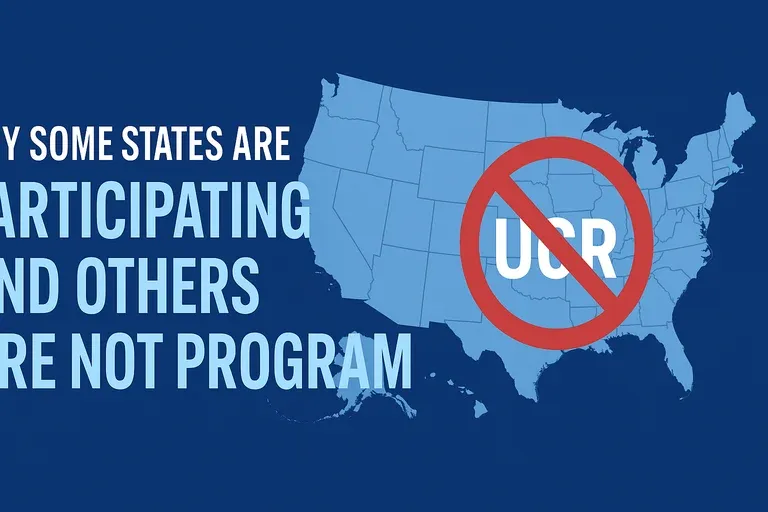
1. UCR Participation Is Optional for States
Although the UCR Program is federally authorized, states are not legally required to participate. Each state independently decides whether to join the program based on:
-
Administrative capacity
-
Cost-benefit analysis
-
Revenue expectations
-
Legal or legislative considerations
Some states simply choose not to operate the program.
2. States Must Collect and Distribute Fees—Not All Want That Responsibility
Participating states are responsible for:
-
Managing UCR fee collection
-
Enforcing UCR compliance
-
Handling audits and disputes
-
Reporting funds to the UCR Board
These activities require staffing, technology systems, and interagency coordination.
A few states opt out because they prefer not to take on the administrative overhead.
3. Some States Rely on Other Revenue Systems Instead
Certain non-participating states have separate revenue structures for commercial motor carriers. For example, they may rely heavily on:
-
Highway use taxes
-
Weight-distance taxes
-
Other state-specific registration fee systems
For these states, the UCR program may be seen as redundant or unnecessary.
4. States Receive Limited Financial Benefit from UCR Funds
UCR revenue is pooled nationally and redistributed. Each state has a legally capped revenue level based on federal law. Because of this:
-
Some states would receive limited financial benefit
-
Administrative costs may outweigh revenue gains
States that see little financial incentive are more likely to decline participation.
5. Differences in Legislative Processes
For a state to join UCR, it typically must pass enabling legislation. In some states:
-
Bills have stalled
-
Political priorities differ
-
Legislative cycles delay participation
Thus, in some cases, lack of political movement—not opposition—keeps them out.
6. Non-Participating States Still Must Recognize UCR
Even though states like Arizona, Florida, Hawaii, Maryland, Nevada, New Jersey, Oregon, Vermont, Wyoming, and others historically did not participate (list can change), they:
-
Still enforce UCR compliance for carriers that should have it, and
-
Recognize registrations from participating states
This is because UCR applies to interstate carriers, regardless of where they are based.
7. How Non-Participating States Handle Their Own Carriers
Carriers based in non-participating states still need UCR registration—but they must register through another participating state.
Example:
A Florida-based carrier registers through a state like Georgia or Alabama.
This ensures nationwide uniformity even when a carrier’s home state opts out.
Summary
Some states are not “participating” in the UCR Program because:
-
Participation is optional
-
Administrative overhead may be too high
-
Revenue benefit may be low
-
They have alternative taxation systems
-
Their legislatures haven’t approved participation
Despite this, all states enforce UCR compliance, and carriers in non-participating states must still register.