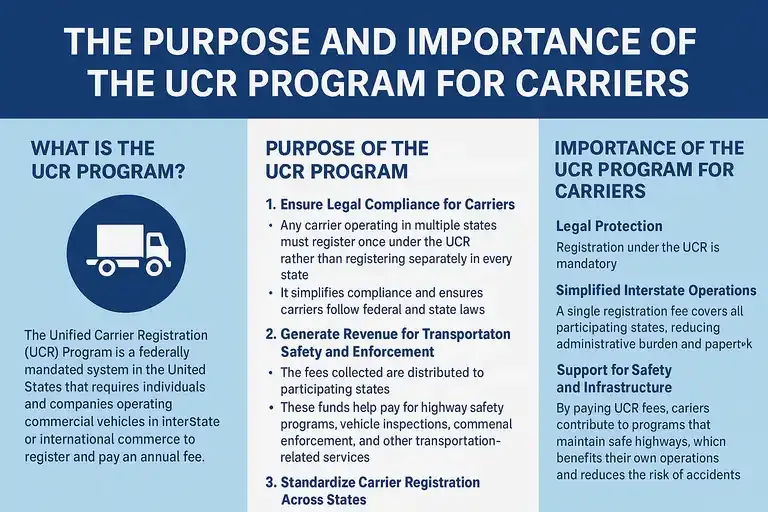
1. What Is the UCR Program?
The UCR Program is a federal registration system that requires individuals and companies operating commercial motor vehicles in interstate or international commerce to register their business annually and pay a fee based on fleet size.
It was established under the UCR Agreement, a federally mandated program that replaced the old Single State Registration System (SSRS) in 2007.
Who Needs to Register
The following entities must register under the UCR Program:
-
For-hire motor carriers (trucking, passenger, or freight)
-
Private carriers operating interstate
-
Brokers and freight forwarders
-
Leasing companies
Even companies without vehicles (like brokers) must register — though they pay the lowest UCR fee category.
2. The Purpose of the UCR Program
The primary goal of the UCR Program is to create a unified, nationwide system for collecting and managing registration fees from interstate transportation companies. These funds are then distributed to participating states to support motor carrier safety programs and enforcement initiatives.
Key Purposes
-
Funding Safety Initiatives: UCR fees directly support programs like roadside inspections, driver safety checks, and crash prevention campaigns.
-
Simplifying Compliance: It replaced multiple state-level registrations, making it easier for carriers to stay compliant under one unified system.
-
Ensuring Fairness: Every carrier that uses U.S. highways contributes proportionally, ensuring all participants help fund enforcement efforts.
-
Promoting Accountability: The UCR system maintains a national database of registered carriers, helping law enforcement verify compliance quickly.
3. How UCR Benefits Carriers
While the UCR Program may seem like just another compliance task, it provides significant benefits for carriers and the industry as a whole.
a. National Compliance Recognition
Once registered under UCR, carriers are recognized across all participating states — eliminating the need for separate permits in each jurisdiction.
b. Reduced Administrative Burden
The program simplifies paperwork by replacing multiple registration processes with one annual online filing.
c. Safer Roads and Fair Competition
By funding enforcement and safety inspections, UCR helps maintain safer highways. It also prevents non-compliant carriers from gaining an unfair advantage by skipping registration fees.
d. Streamlined Enforcement
Law enforcement agencies can verify compliance instantly through digital systems like FMCSA’s SAFER and UCR databases, reducing downtime at checkpoints.
4. Consequences of Non-Compliance
Failing to register or renew UCR can lead to:
-
Fines ranging from $100 to over $1,000 per violation
-
Vehicle detainment or out-of-service orders
-
Suspension of operating authority
-
Difficulty renewing USDOT or MC numbers
Non-compliance can quickly become more expensive than the registration fee itself, which is relatively low compared to other federal filings.
5. How to Register
Carriers can register or renew online through the website:
www.fmcsa.me
You’ll need:
-
Your USDOT number
-
Fleet size (based on the number of power units)
-
Payment method (credit card or e-check)
Registration opens every October 1st for the upcoming year.
6. Key Takeaway
The UCR Program is more than a regulatory obligation — it’s a cornerstone of highway safety funding and fair industry participation.
By maintaining your registration, you not only stay compliant but also contribute to a safer, more efficient transportation network for everyone on the road.