What Is the UCR Program?
The UCR program requires certain motor carriers, brokers, and freight forwarders that operate in interstate commerce to register and pay annual fees based on fleet size. The fees support state safety enforcement programs.
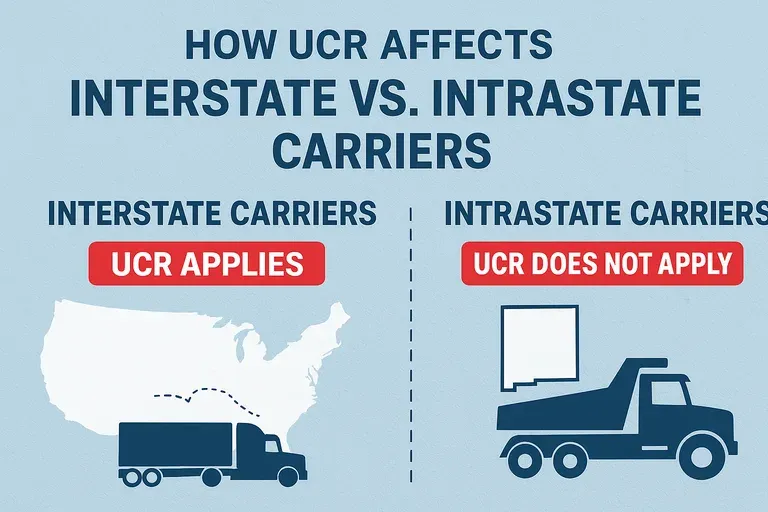
Interstate Carriers
UCR Applies — Interstate carriers must register.
Interstate carriers are any companies that move passengers or property across state lines, into or out of the country, or between two points within a state when the route passes through another state or foreign country.
Examples of interstate operations:
-
Picking up freight in Texas and delivering in Oklahoma
-
Driving from Florida to Georgia with an empty truck
-
Operating within one state but crossing into another state as part of your route
-
Hauling goods from the U.S. to Canada or Mexico
Why interstate carriers must file UCR:
If you operate interstate, your DOT number is entered into the FMCSA’s MCMIS system as an interstate operation. This automatically triggers UCR applicability.
Risks of non-compliance for interstate carriers:
-
Roadside fines (often $150–$1,000 depending on the state)
-
Out-of-service orders
-
Being flagged during inspections
-
Delays at scales
Intrastate Carriers
UCR Does Not Apply — as long as you operate strictly intrastate.
Intrastate carriers operate only within one state and do not engage in any form of interstate commerce.
Examples of intrastate operations:
-
A dump truck company hauling only within one state
-
A local delivery fleet that does not cross state borders
-
A towing company operating solely in-state
Important: Having a USDOT Number DOES NOT automatically require UCR.
Some states require intrastate carriers to obtain a DOT number for safety purposes. But if the carrier’s operation type on the DOT registration is listed as intrastate, UCR does not apply.
Borderline or Gray-Area Situations
Certain activities still count as interstate commerce even if the truck never crosses state lines:
You are considered interstate if:
-
You haul goods that originated outside the state (even if you only deliver locally)
-
You haul goods that will be shipped out of the state after your delivery
-
You operate in “interstate commerce exempt” categories that still fall under DOT authority
This is where many intrastate carriers accidentally become interstate carriers without realizing it.
Switching Between Intrastate and Interstate
If a carrier switches operation types (for example, starts hauling interstate after operating intrastate-only), they must:
-
Update their USDOT registration (MCS-150)
-
File the UCR for the current year (fees apply immediately)
State Enforcement Differences
UCR is a federal program enforced by participating states. Some states — such as Indiana, Georgia, Utah, and Texas — are known for more aggressive enforcement. Others conduct periodic blitzes or focus enforcement at weigh stations.
Quick Summary
| Carrier Type | Must File UCR? | Key Notes |
|---|---|---|
| Interstate carriers | Yes | Required for all interstate operators, even with no freight on board |
| Intrastate carriers | No | Only if they truly operate in-state and not in interstate commerce |
| Brokers, freight forwarders, leasing companies | Yes | Must file UCR even without vehicles |