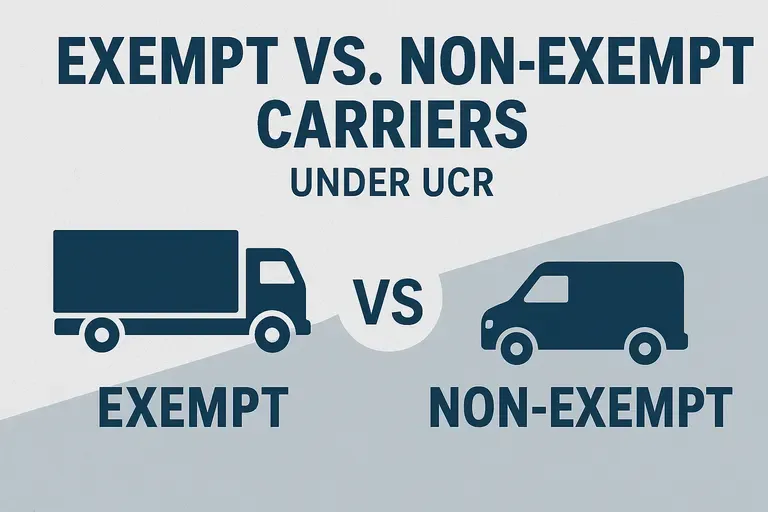
Who Is Required to Register? (Non-Exempt Carriers)
The following must register under the UCR program:
1. For-Hire Motor Carriers (Interstate)
Any carrier transporting goods or passengers across state lines for compensation is required to comply with UCR.
2. Private Motor Carriers (Interstate)
Companies that transport their own goods across state lines using commercial motor vehicles (CMVs) must register.
3. Brokers
Transportation brokers arranging interstate moves must register, even though they do not operate CMVs.
4. Freight Forwarders
Freight forwarders handling interstate shipments, even without owning trucks, fall under UCR.
5. Leasing Companies
Companies leasing commercial motor vehicles engaged in interstate commerce must register.
Who Is Exempt From UCR Registration?
Some carriers and transportation operations are not required to register for UCR. These include:
1. Purely Intrastate Carriers
Carriers that operate only within a single state and never cross state lines are exempt—unless the state requires otherwise (most do not).
2. Private Carriers of Passengers (Not For-Hire)
Organizations transporting passengers as part of their business—for example, churches or nonprofits—are exempt if the travel is not for compensation.
3. Driveaway/Towaway Operations Using Personal Vehicles
If a driver is transporting a personal vehicle (not a CMV) as freight, it may fall outside UCR requirements.
4. Carriers Operating Exclusively with Vehicles Under 10,001 lbs
If all vehicles are under the 10,001 lb GVW threshold, the carrier does not qualify as a CMV operator and is therefore exempt.
5. Government-Owned Vehicles
Federal, state, tribal, county, and municipal government fleets are exempt.
6. Charitable or Relief Organizations (Certain Conditions)
Vehicles used for emergency relief or charitable purposes may qualify for exemption depending on the operation.
Key Differences at a Glance
| Category | Non-Exempt (Must Register) | Exempt (Do Not Register) |
|---|---|---|
| Interstate Travel | Yes | No (intrastate only) |
| Vehicle Weight | CMVs 10,001 lbs+ | Vehicles under 10,001 lbs only |
| Type of Operation | For-hire, private, brokers, freight forwarders, leasing companies | Non-profits, government, small vehicles |
| Passenger Carriers | For-hire only | Not-for-hire/private passenger carriers |
| Annual UCR Fee Required | Yes | No |
How to Determine Your Status
Ask yourself:
-
Do I cross state lines?
-
If yes, UCR likely applies.
-
-
Do I operate or manage vehicles 10,001 lbs or heavier?
-
If yes, UCR likely applies.
-
-
Do I transport passengers or goods for compensation?
-
If yes, UCR most likely applies.
-
-
Am I a broker or freight forwarder involved in interstate commerce?
-
If yes, UCR applies even without vehicles.
-
Why This Matters
Failing to register when required can lead to:
-
Fines up to $5,000+ per truck
-
Out-of-service orders
-
Compliance audits
-
Delayed operations
Understanding your exempt or non-exempt status is the first step in staying compliant.