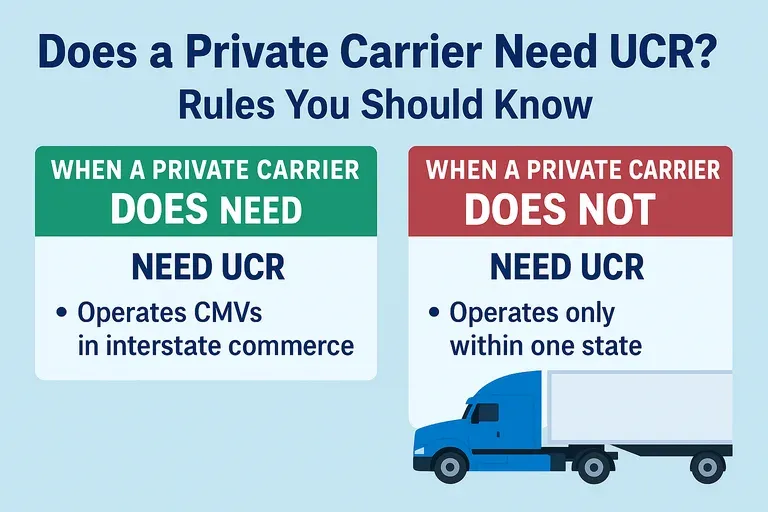
1. When a Private Carrier Does Need UCR
A private carrier must register for UCR if it meets all of the following:
-
Operates a commercial motor vehicle (CMV) across state lines
-
The vehicle is 10,001 lbs GVW/GVWR or higher, or
-
The vehicle transports more than 10 passengers, or
-
The vehicle transports hazardous materials requiring placarding
If these conditions apply, the company must file UCR even if it does not haul for hire.
Examples of private carriers who must register:
-
A construction company hauling its own equipment from Texas to Oklahoma
-
A grocery chain delivering its own products from one state to another
-
A manufacturer transporting its goods across state lines
2. When a Private Carrier Does Not Need UCR
A private carrier is exempt from UCR if:
-
It operates only within one state (intrastate only)
-
Its vehicles are under 10,001 lbs and do not carry placarded hazmat
-
It is a purely agricultural farm operation using exempt farm vehicles
-
It does not operate any CMVs as defined under UCR rules
Examples of private carriers that do not need UCR:
-
A landscaping company using a ¾-ton pickup only inside one state
-
A baker delivering goods locally with small vans
-
A small business with vehicles not meeting CMV weight or hazmat thresholds
3. Important Clarification
UCR applies based on vehicle type and interstate movement, not based on whether the company is “for hire” or “private.”
Many private carriers are surprised to learn they must pay UCR fees simply because they cross state lines with applicable vehicles.
4. Penalties for Non-Compliance
States enforce UCR through:
-
Fines ranging from $100 to over $1,000
-
Vehicle detention at roadside inspections
-
Potential out-of-service orders
Some states are stricter than others (e.g., Indiana, Georgia, Texas).
5. Quick Checklist
If you answer “YES” to these two questions, you need UCR:
1. Do you cross state lines?
2. Is your vehicle 10,001 lbs+ GVWR/GVW or placarded for hazmat?
If yes → UCR Required
If no → UCR Not Required