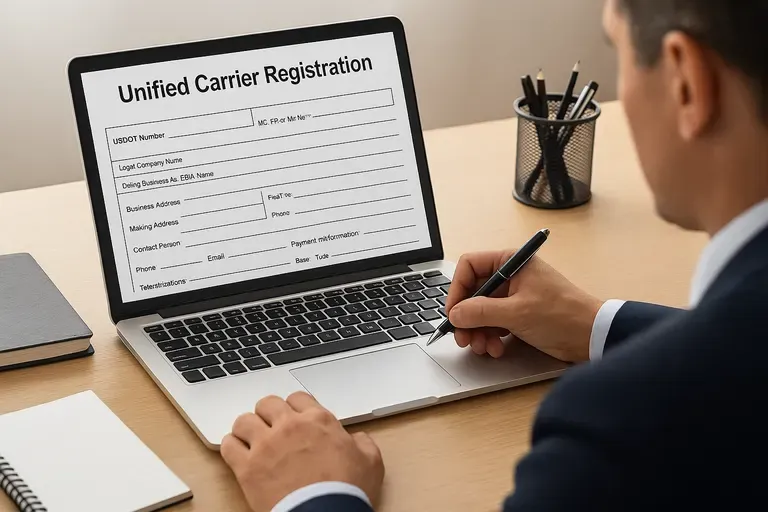
1. USDOT Number
Your U.S. Department of Transportation (USDOT) number is the cornerstone of UCR registration.
It’s used to identify your company and verify your operating status.
Tips:
-
Verify your USDOT information on the FMCSA Safety and Fitness Electronic Records (SAFER) system before filing.
-
If your USDOT is inactive, revoked, or under a different name, you’ll need to update it with FMCSA first.
2. MC, FF, or MX Number (if applicable)
If you operate as a for-hire carrier, broker, or freight forwarder, include your Motor Carrier (MC), Freight Forwarder (FF), or MX number.
This helps confirm your regulatory classification under FMCSA.
3. Legal and Doing Business As (DBA) Names
Enter your legal company name as registered with the U.S. Department of Transportation or Secretary of State.
If your company operates under a DBA (Doing Business As) name, include it as well.
4. Business Address and Contact Information
Provide your:
-
Principal business address
-
Mailing address (if different)
-
Contact person’s name
-
Phone number and email
Tip: Use accurate, up-to-date contact details to ensure you receive UCR renewal notices and enforcement updates.
5. Tax Identification Number (EIN or SSN)
Your Employer Identification Number (EIN) or Social Security Number (SSN) is used for verification purposes.
This information is not publicly displayed but is essential for tax and identity matching.
6. Fleet Size — Number of Commercial Vehicles
One of the most critical parts of UCR filing is determining your fleet size, which determines your fee bracket.
You’ll need to report the total number of commercial motor vehicles (CMVs) you operated in interstate commerce during the last 12 months.
Include:
-
Power units (tractors, straight trucks)
-
Owned, leased, or registered-for-use vehicles
Exclude:
-
Trailers
-
Non-commercial or intrastate-only vehicles
7. Payment Information
UCR fees are based on your fleet size and are payable online via:
-
Credit card
-
Debit card
-
Electronic check (ACH)
Tip: Always use the www.fmcsa.me— avoid third-party sites that may charge extra processing fees.
8. Participating State
You’ll need to select your base state for filing.
This is typically:
-
The state where your business is headquartered and
-
A state that participates in the UCR program
If your home state doesn’t participate (e.g., Arizona, Florida, Oregon, Wyoming, etc.), you must choose a neighboring participating state to register through.
9. Carrier Type Classification
You’ll indicate your operation type as one of the following:
-
Motor Carrier (for-hire or private)
-
Broker
-
Freight Forwarder
-
Leasing Company
Some entities, such as brokers and leasing companies, pay the lowest UCR fee tier, since they don’t operate CMVs.
10. Proof of Active Authority and Insurance (if applicable)
While not always required to upload, your active FMCSA operating authority and insurance filings (BMC-91, BMC-84, etc.) must be valid for your UCR to remain in good standing.
Bonus Tip:
Keep a Copy of Your UCR Receipt
You are not required to carry a paper copy in the truck, but it’s smart to keep a digital or printed copy in your office records.
Law enforcement verifies compliance electronically through your USDOT number.
Summary Checklist
| Required Information | Description |
|---|---|
| USDOT Number | Active and current FMCSA registration |
| MC/FF/MX Number | For for-hire carriers, brokers, freight forwarders |
| Legal & DBA Name | Matches FMCSA records |
| Business Contact Info | Accurate mailing and email details |
| EIN/SSN | Used for identification |
| Fleet Size | Determines your fee bracket |
| Payment Details | Credit card or ACH |
| Base State | Participating UCR state |
| Carrier Type | Motor carrier, broker, forwarder, etc. |
| Insurance Status | Must be active for operating authority |
Final Thoughts
Submitting your UCR registration accurately saves time, prevents enforcement penalties, and ensures uninterrupted interstate operations.
Before filing, take a few minutes to verify your USDOT and fleet data — it’s the simplest way to stay compliant year after year.